Sunday, July 14, 2013

From Birth of a Nation to Stand Your Ground: Trayvon Martin and the New Era of Lynching


The "Not Guilty" verdict rendered by six jurors in a Sanford, Florida circuit court July 13, 2013 inaugurates through legal precedent a new era of lynching in the United States of America. Whatever you may think of the adequacy or inadequacy of the case presented by the prosecution or the appropriateness of the verdict in light of the facts presented, the ultimate effect of the Trayvon Martin verdict fundamentally legitimates racial profiling and the indiscriminate murder ("lynching") of persons of color by armed citizen vigilantes as well as law enforcement officials. 

The criminalization without evidence of Trayvon Martin, by cop wannabe George Zimmerman and his defense team, is the central and most defining element of this new form of racial lynching. Without a shred of evidence suggesting any actual criminal activity, George Zimmerman racially profiled this young man as evidenced by the 9-1-1 call ("...these assholes always get away..."), followed him, initiated a fight, and shot him dead. Again, without a shred of evidence of any criminal activity, Zimmerman's defense team continued to criminalize Trayvon Martin and effectively transformed a 150 pound 17-year old with a bag of Skittles and a bottle of iced tea into a thug and criminal predator. In a gated community in Sanford, Florida on February 26, 2012 and in the courtroom Trayvon Martin became the modern Bigger Thomas, and on his body they imprinted every dominant cultural fear of Black masculinity. 

The combined effect of Zimmerman's profiling and O'Mara and West's "Bad Nigger" defense strategy is tantamount to the thousands of unsubstantiated cries of "Black rapist" that characterized the era of lynching. There is simply no proof of Martin's wrongdoing. Trayvon's crime was being Black. Pure and simple. He and Oscar Grant and thousands of unpublicized others are the modern day versions of Emmett Till and the Scottsboro Boys. They don't have to do anything in order to be considered suspects. Merely in terms of their physical/racial appearance, they are suspects.

The second defining element of the new lynching is the proximity of Zimmerman's profiling and the case presented by the defense to a history of racial stereotyping, including the pervasive tropes of minstrelsy that continue to resonate through corporatized mass media representations of blackness including contemporary rap and hip hop music. The 19th century Buck, the 20th century Badass Nigger, the late 20th and 21st century Thuglife Nigga, were all present in the imaginations of Zimmerman and the six who stood in judgment of his actions. Mark O'Mara's presentation of a grainy photo of a shirtless Trayvon Martin effectively linked Martin with a history of minstrel and gangsta rap images of Black rapists and gang members. O'Mara would follow that up with an even more dramatic presentation of a chunk of concrete, effectively weaponizing the unarmed teenager and sealing his transformation to violent Black Thug. These narratives and images were all imprinted on the body of Trayvon Martin and in fact continue to be writ large on his body as the American news media analyzes the case and verdict.

Indeed, as Trayvon became the prototypical "Buck," Rachel Jeantel,  the last person that he spoke to before he died, became through proximity a contemporary "Mammy." Defense attorney Don West daughter's indiscreet Instagram photo "We Beat Stupidity" was a not only a direct attack on the comportment and diction of Jeantel but a way of linking her to this pervasive history of minstrel-era tropes. In so doing, Jeantel was also transformed into a racialized and criminalized object, obfuscating the possibility of empathizing with her very understandable reluctance to be in the public eye or the depths of her grieving. Jeantel was symbolically lynched before a nationwide audience that jeered at her grieving rather than daring to engage her as a fellow human being and understand her pain. It was as though she was being taunted by the lynch mob.


As an African American and the father of a young African American man, I felt further taunted by the lynch mob with the defense team's post-verdict comments. Few empathetic words for a family that must now live with the loss of a child. No contrition. I'm absolutely incensed by the suggestions of Zimmerman's brother, Robert Zimmerman and Zimmerman defense attorney Mark O'Mara that it was an outrage that this case should ever have gone to trial in the first place. Their statements were like every other lynching, where the mob left the body hanging from the tree, vivisected from gullet to groin, charred and burned.


Adam Weinsten has published the photo of a lynched Trayvon Martin at Gawker. Only look at this if you think you can handle it. http://gawker.com/this-courtesy-of-msnbc-is-trayvon-martins-dead-body-753370712

This is difficult to view, as difficult as pictures of Emmett Till, perhaps even more so. But if you can handle this, you will not see the Black Buck, the Thug, the Gangsta Nigga lying still in the grass. You will not see someone that George Zimmerman could reasonably fear. You will see a child in khakis and new sneakers with his hands at his sides and his eyes and mouth open in realization of the horror that was happening to him. 


As the trial unfolded, I wondered whether the prosecution was really trying. This really should have been an open and shut case. One man playing cop follows another man merely because of the color of his skin, initiates a fight, and shoots him dead. What are we arguing about? What was Trayvon Martin's crime?  Why didn't the prosecution make more of Zimmerman's record of phoning the police over 300 times regarding other "suspects" that he had profiled? Didn't Martin, who was within proximity of the home where he was staying with his father and his father's fiancee, have the right to defend himself against an armed stranger pursuing him that rainy night? If anyone in this case had the right to "stand their ground," it was Trayvon, whose alleged violence against Zimmerman reads more like a defensive action against a potential stalker than anything else. Why didn't the prosecution make more out of Zimmerman's failure to identify himself as Neighborhood Watch? Why did the prosecution so consistently avoid the most obvious aspect of this case: race? Why didn't chief prosecutor Angela Corey, a woman who could have appealed to a jury of six women, personally handle this case? Why did state prosecutor Norm Wolfinger recuse himself from the case? Why was Zimmerman only charged with 2nd degree murder after prolonged activism, including the petition of thousands through Change.org? Why wasn't Zimmerman at least charged and held for manslaughter the night of February 26 after killing Trayvon Martin? Since when do police investigators simply accept the word of a killer?

It should be noted that there are probably far greater forces at work here, manipulating ideologies of race as dominant cultural players have always done. There's a larger political game here that the prosecution may have been very much aware of. Certainly this is more than merely a shot in the arm for American racism. It's clear that this verdict is a triumph for the National Rifle Association and the gun lobby and ALEC (American Legislative Exchange Council) and the ALEC-sponsored Stand Your Ground laws that exist in 24 states in the union. The Zimmerman verdict protects not only the possession and concealed carry of firearms, but also exonerates all who possess firearms and concealed carry permits from the unwarranted discharge of those firearms. The "Not Guilty" verdict of the Zimmerman trial legitimates the possibility of an average citizen acting as judge and jury and carrying out a capital sentence ("lynching") on the basis of racially-based suspicions ("profiling") and fears. It gives legal authority to the lynch mob. 

In the end, we have to do what we've always done in the wake of a lynching. We have to go out and take down the body, give our brother a proper burial, and uproot the lynching tree - for the tree can no longer exist. Like the great Ida B. Wells, we must use whatever media is at our disposal to raise awareness of these lynchings and the many Trayvon Martins around the country. We must hang banners outside of our homes and offices, alerting one another when another one of us has been lynched. We must initiate a movement to fight the ravages of the criminal justice system, Stand Your Ground, and the criminalization, incarceration, and lynching of our people. If the lynching of Trayvon Martin doesn't convince you, perhaps the contemporaneous lynchings of 18-year old Ramarley Graham, shot in his bathroom in the Bronx by police a few weeks before Trayvon; or the lynching of 21-year old Shawn Bell shot more than 50 times by NYPD; or the shooting of unarmed 19-year old college student Kendrec McDade in Pasadena, California will. These names and events have to be chronicled and remembered. It is time for another Civil Rights Movement. 


Wednesday, January 16, 2013

I Know You Know


I Know You Know:
Esperanza Spalding's Hybrid, Intertextual, Multilingual, Relevant Jazz Aesthetic


For all of you who supported blog on Esperanza Spalding, I promised to let you know when the academic version of the piece got published. It is currently available at the below link on Americana: The Journal of American Popular Culture (1900-Present). The article is a far more thorough examination of the so-called "death" of jazz and Spalding's positive influence on the genre. More detail, more theory, more analysis of her music. Enjoy! And thanks to all of you for your continued support!


http://www.americanpopularculture.com/journal/articles/fall_2012/baham.htm


Sunday, January 6, 2013

Don't Call Me "Nigger," Whitey: Django Unchained and the Cinematic Debut of African American Slave Insurrectionist Agency


Nicholas L. Baham III, Ph.D.


Far from being a mere "spaghetti western" in blackface, Quentin Tarantino's Django Unchained (2012) rightfully restores the agency of African Americans who fought the system of slavery through violent insurrections from 1619 to 1865 and launches a new cinematic tradition of the African American warrior maroon. Make no mistake, Django Unchained pays scant attention to moral suasion and oratory, although Django's developing command of the English language is central to his freedom. Tarantino's buckets-of-blood narrative revels in the violence of insurrection and drinks liberally from the well of sweet revenge. Django Unchained is a raucous, unruly and unapologetic celebration of a freedom born of violent resistance and brilliantly effective in foregrounding both violence and the African American struggle for freedom as a quintessentially American. Along the way, Django Unchained also offers a stinging and sardonic critique of the construction of whiteness in the antebellum South, reminds us of the ever-present sadism behind the genteel veneer of the slaveholding class, savagely ridicules many of the fundamental assumptions of the pseudo-science of race, and leaves little doubt about the importance of class disparity and betrayal amongst the enslaved as a factor in maintenance of this peculiar institution. 

Django Unchained is fundamentally an ode to the agency and the violent resistance of enslaved Africans, and, as such, is unique in American cinematic history. There has never been a successful American cinematic treatment of Gabriel Prosser, Denmark Vesey, Nat Turner -even in spite of the possibilities afforded by William Styron's novelization- Harriet Tubman, Sojourner Truth, the Dismal Swamp Maroons, the 1st and 2nd Seminole Wars, nor even of Frederick Douglass, to name a few. With the exception of Glory (1989), a film about the Massachusetts 54th Regiment of the Volunteer Army, and Amistad (1997) few American films give proper due to the role of African Americans in obtaining their own freedom. Glory suffers on one hand in its tendency to focus more on the life of the 54th Regiment's European-American commander Col. Robert Gould Shaw (Matthew Broderick) than the soldiers in this all-Black regiment and, in so doing, cannot make any necessary historical statement on the critical importance of African American soldiers  in turning the tide of the Civil War nor of the courage of the 85% of all eligible Black men who volunteered to fight in the war to end slavery in America. When Amistad abandons its most passionate moments aboard the titular vessel and bogs down in court room debates, the agency of Cinque -albeit heroically portrayed by Djimon Hounsou- is replaced by an emphasis on the skill and good intentions of John Quincy Adams (Anthony Hopkins) and trial lawyer Roger Baldwin (Matthew McConaughey). In spite of the presence of Black abolitionist Theodore Joadson (Morgan Freeman), Amistad takes a narrative turn, becoming more of a paean to white liberalism and moral suasion than a celebration of Black revolt.


Violent resistance is a central trope of cinematic renditions of almost every American war, and particularly the American Revolutionary War. Contemporary American Revolutionary War films that glorify violence as a medium of independence include the HBO mini-series John Adams (2008), The Patriot (2000), and Revolution (1985). In each, whiteness, violence, and independence are conflated as the fundamental variables of American identity, reaffirming violence as central to American discursive concepts of "independence" and "manhood." That our founders seized their independence from the British by force is highly consequently in American self-characterizations of independence and indeed is a fundamental building block in the subsequent constructions of the "frontier spirit," the notion of Americans as a "can do" people, the more contemporary conservative political notion of "pulling yourself up by your own bootstraps," and the fierce allegiance to Second Amendment principles. 


The same racialized contradictions that were present at the birth of our nation are present in cinematic representations of the era. While American Revolutionary War films celebrate violence, there are no major American films that celebrate the violent resistance of African Americans against the system of chattel slavery. This is perhaps the most substantive and as of yet unnoticed aspect of Django Unchained. Tarantino's film creates a space for African Americans in particular -and perhaps people of color generally speaking- to participate in core American discourses of violence as a medium of independence. There can be no doubt that in the long term such creative myth-making contributes to the sense of democratic belonging. Contrary to many of the contemporary conservative critics of race, democratic belonging can never happen under the conditions of historical amnesia, a mere forgetting of racial trauma, but can perhaps happen in an atmosphere where all of our histories are presented, debated, and creatively constructed.


Django Unchained does more than present the justifiably embittered violence of the enslaved. As Frantz Fanon might suggest, the violence of Django Unchained is central to the transition from slave to free status and the emergence of the identity of what Richard Price chronicled as "the maroon" and the culture of the runaway slave (Price 1996).  The "maroon" is properly defined as the escaped slave who not only runs to freedom but establishes a settlement often within proximity of the plantation and engages in protracted war against his or her former plantation and the system of slavery. The term "maroon" derives from the Spanish word "cimarron," meaning literally "living on mountaintops."


Django Unchained is not the first cinematic presentation of the warrior maroon, but it is the first American presentation of this historical figure. Carlos Diegues' 1984 film, Quilombo, for example, presents the history of Quilombo de Palmares, a 17th century mountain settlement of escaped slaves who revolted against their Portuguese masters in 1605 and waged a protracted war against the system of slavery in Brazil. Led by the likes of the charismatic Ganga Zumba and later King Zumbi, these warrior maroons developed the fighting style of capoeira and guerrilla tactics and held off Portuguese incursions against their settlement until 1694. Quilombo, like Django Unchained,  is noteworthy for maintaining the point of view of the insurrectionists.


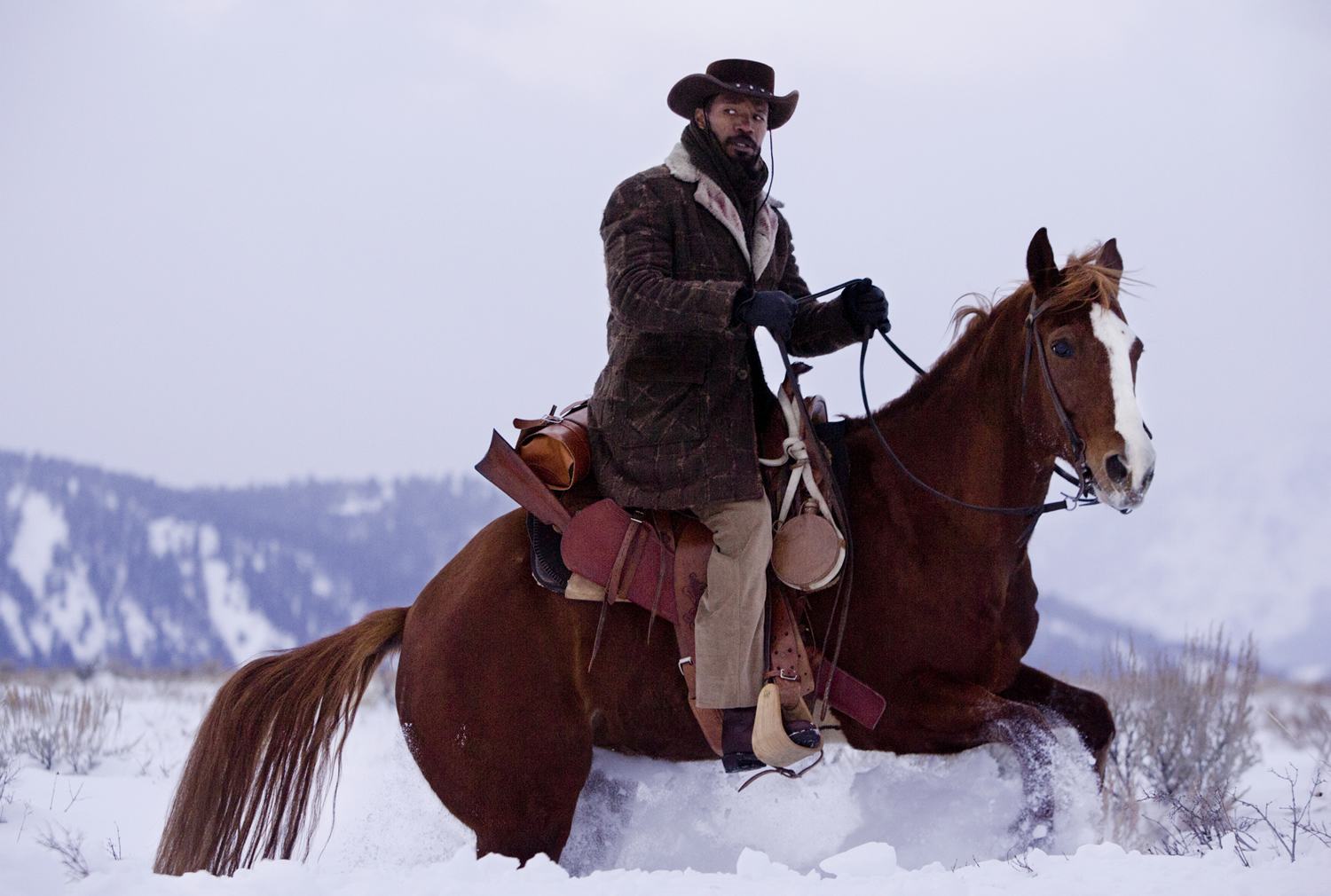
Tarantino's frequent mise-en-scene of Django crossing mountain passes on horseback as a newly minted bounty hunter is a persistent allusion to the literal meaning of the warrior maroon. Django's acceptance of employment as a bounty hunter (because it means that he can kill white men and get paid) and his emergence as a free man vis-a-vis the power of the gun (for which he displays a natural talent) is another nod to the transformative potential of violence within American discourse.


Tarantino's critique of the conclusions of the racist "pseudo-science" of phrenology further underscore his commitment to Black agency and his understanding of the warrior maroon. Calvin Candie's (Leonardo DiCaprio) presentation of the skull of his father's servant and his terrifying soliloquy on the three indentations at the base of the "negro skull" that predetermine servility is textbook phrenology. So powerful are the fictional discourses of race that even as Django's presence as an articulate free man of color - posing as an "expert" on Mandingo fighting- powerfully contradicts his conclusions, Calvin Candie can only conclude that Django must be an exception to the rule, an example of the "one in ten thousand," and he reluctantly admits that the one in ten thousand Django's will perhaps ultimately "evolve" as the norm. 

Tarantino plays Django against the pseudo science of race brilliantly. In spite of the gun violence in the film, Tarantino largely accomplishes this through a nuanced understanding of the intellectual power of Django. In effect, Django's tongue is frequently as powerful as his gun, and this lends Django's experience of freedom a fully three-dimensional quality. The repeated motive of Django spelling his name for whites -"The 'D' is silent"- testifies to Django's growing intellectual independence in a setting in which literacy is palpable power and freedom. Django's developing literacy is always played against the foil of hilariously inarticulate poor southern whites who serve as overlords on the plantations of the wealthy as a means of diminishing the fear they elicit as they bear the whip and the gun. His boldness in calling Calvin Candie's lawyer and his overlords "niggers" is indicative of a linguistic re-appropriation of this slave term far more sophisticated and powerful than we have seen from a 40-year history of hip hop. His chastisement of Candie's bodyguard for wearing his hat indoors also testifies to his critique of the pretension of southern manners and gentility and his ability to call out the contradictions of the ruling class at every turn. When Django deceives the Australians as they transport him to another plantation where he will meet certain death - after his ploy with Dr. King Schultz is discovered -  it is his literacy that saves the day when he produces the saved hand bill from his first kill as a bounty hunter. 


But it is the memorable line, "...do I sound like a slave to you?" uttered in the midst of that deception that most powerfully resonates Tarantino's construction of Django's literacy as a weapon. It is a line that I've found myself repeating over and over again after watching the film.


Tarantino's film not only returns historical agency to the African American warrior maroon as the central agent in the struggle for freedom, but he also gives agency to the enslaved in maintenance of the system of slavery. The house negro is generally an easy target in the critique of slavery, but Samuel L. Jackson's nuanced portrayal of Calvin Candie's house slave Stephen locates the maintenance and survivability of the peculiar institution on the complicit and profoundly invested shoulders of enslaved persons. Stephen, who feigns a limp and enjoys many of the privileges of the house, including the freedom to drink his master's brandy in his posh sitting room, is presented as a co-conspirator who sheds self-interested tears upon the death of his master. He attempts to remind his master that "niggers" cannot sleep in any of the rooms of the big house and ultimately reveals his suspicions as to the true motives of Dr. King Schultz and Django. In spite of the ultimately horrific consequences of this confession for Calvin Candie, his family, and his property, Stephen is presented as a catalyst and an active player in the maintenance of Candyland. He is more than a mere house slave, he is an absolutely indispensable co-conspirator.


Much has been made of tonal comparisons between Steven Spielberg's Lincoln and Tarantino's Django Unchained. Speilberg's Lincoln is pious and reverential of the period. Tarantino's Django Unchained is irreverent and mocks the Southern planter classes.  

But the humor of Django Unchained is the comedy of abjection, eliciting audiences to laugh at the very fact that they find themselves laughing at a movie whose subject matter is slavery. It's the laughter we all experience when we find ourselves laughing at socially awkward and uncomfortable situations. It's the kind of laughter that the great stand-up comedians of the 1950s and early '60s like Lenny Bruce and Dick Gregory drew from us when talking about racism and religion and sexuality in an era of repression and racial segregation. It's the kind of laughter that has long been the perfect vehicle for social commentary. And interestingly, in spite of the relative piety of Lincoln, the script is riddled with far more historical inaccuracies - the greatest of which is the absence of Frederick Douglass as Lincoln's true voice of conscience- than even the fictional Django.

In fact, Tarantino's brief historical inaccuracies can be forgiven as a necessary evil for ridiculing the southern planter class and the system of slavery itself. For example, his depiction of the Ku Klux Klan, or at least a proto-Klan posse led by Spencer "Big Daddy" Bennett (Don Johnson), is historically misplaced, since the KKK was largely a child of the Reconstruction era. But the sight gag of poorly cut eyeholes for the flour sacks that members of the posse wear allows a powerful and reaffirming laugh at the white southern underclass who have bought into the ideology of white supremacy without being able to lay claim to any of its material spoils. This is but the first of many such critiques of the complicity of the southern white poor.


In light of the historic presentation of African American insurrectionist agency -as well as house negro agency- controversies surrounding the film (e.g. Tarantino's use of the word "nigger" over 110 times in the film) are misplaced. Spike Lee was among the first to rebuke the film, albeit without having seen it: "I can't speak on it 'cause I'm not gonna see it...all I'm going to say is that its disrespectful to my ancestors. That's just me...I'm not speaking on behalf of anyone else."  He subsequently tweeted, "American slavery was not a Sergio Leone Spaghetti Western. It was a Holocaust. My ancestors are slaves stolen from Africa. I will honor them."

As much as I revere Spike Lee's work, I beg to differ. Wherever the agency of ancestors is invoked, particularly with respect to their struggle for freedom, my ancestors have been honored and represented.


Saturday, December 29, 2012

Why Esperanza Spalding Matters


Nicholas L. Baham III, Ph.D.


A longer and more academic version of this inaugural post is being published by Americana: The Journal of American Popular Culture 1900-Present in the Fall 2012 issue. You can find that at:


I'd be very interested in any opinions about either version.

As for The Upper Room at nicholasbaham.blogpost.com at Google+, well I finally decided to catch up with the times and initiate a blog on culture and politics that might serve as a sketchpad for ideas I've been working on as an academic. Some of these ideas might become the subject of more expansive articles and conference papers and others might find their way into my teaching at Cal State East Bay. I trust that this will be a great way for me to get a little reader feedback, find out whether my musings resonate, and whether further directions remain to be explored.

I've been working on a critical piece about Esperanza Spalding as an avatar of a new jazz idiom that radically broadens the very definition of jazz and creates new communities of listeners. We've all read and heard a great deal about the "death" of jazz and its ever-declining commercial sales and aging concert audiences. As a jazz lover, I've grown tired, bored, disinterested in the endless jazz eulogies. I've been looking for that bright horizon where a new jazz is coming into view. And when I first heard Esperanza Spalding's work, I knew the moment had arrived.

I've been intrigued with Esperanza Spanlding's work ever since her receipt of the 2011 Grammy Award for Best New Artist. This was the first time that a jazz artist was accorded that particular honor and, in my opinion, it signaled possible new directions in jazz with a specific emphasis on genre hybridity, intertextuality, and maybe even a return of socially relevant discourse in American music.


As is generally the case, when you come across a good idea the universe begins providing all the help it can to keep the thing going.  On April 30, 2012, somewhere around the time that I conceived of writing about Spalding, jazz pianist and composer Jason Moran – the recently installed Artistic Advisor for the Kennedy Center- was interviewed by NPR’s Neil Conant about the future survivability of jazz music. Moran, who succeeds Billy Taylor as only the second Artistic Advisor at the Kennedy Center, presented the outline of a theory of “re-contextualization” where the very definition and aesthetic boundaries of jazz music necessarily expand in order for jazz to survive. His argument focused on genre hybridity, and he spoke of his own performative “re-contextualization” of Afrika Bambaataa’s “Planet Rock” and his collaboration with Meshell Ndegeocello to transform the music of Fats Waller into contemporary dance music.

After listening to and transcribing portions of Jason Moran's interview on NPR, I decided to evaluate Spalding under the lens of his concept of "re-contextualization." Moran's ideas were sketchy, but he clearly communicated his belief that jazz could serve as an umbrella aesthetic with a fundamental emphasis on improvisation that could perpetually incorporate disparate musical genres and perhaps even the “texts” of non-musical art forms. What else could account for the broad history and international appeal of jazz music but its ability to infinitely incorporate new ideas and new histories?

I’m intrigued by the notion of building a theoretical principle around a radio interview. Why not? For me, Moran’s “re-contextualization” incorporates what I’d call a “radical genre hybridity,” intertextuality, and some element that re-engages jazz with contemporary public discursive formations. I want what William Banfield has called “music that matters” and I’ve been waiting for the prophetic voice to return to American popular music and for our music to challenge power and structures of domination.

I am specifically interested in whether Spalding's particular artistic expression of "re-contextualization" might afford opportunities for meaningful connections with contemporary discursive formations of social/cultural hybridization in a world experiencing contestations over the Enlightenment assumptions of race, class, gender, and sexual identity politics. I wonder if Spalding's incorporation of disparate musical genres amounts to anything more radical than any other previous instance of genre bending in jazz (e.g. Latin jazz, Third Stream, fusion, etc.) and whether there was any significant social/cultural messaging beneath the formal aspects of her expressions of genre hybridity. 


I began a closer listening of Spalding's third release Chamber Music Society.  John Coltrane used to call it a practice of "repeated listening" until you understood what the musician was trying to convey. On one level her album is pays homage to her classical training, but she layers pre-Baroque acoustic bass, cello, violin, and viola with inspired moments of jazz improvisation, soul, funk, and frequently Brazilian vocals. Of particular interest is Spalding's composition, “Little Fly,” where she integrates the eighteenth century poetry of William Blake with NuSoul lyricism. Spalding's intertextuality –her specific blend of poetry and music- reminds you of inspired moments like the unlikely pairing of Arthur Koestler's 1968 evolutionary critique of insanity and violence with the hybrid punk-reggae-jazz cocktail of the Police on Ghost in the Machine (A&M 1990). On "Little Fly," Blake’s 18th century verse on life and death meets '70s soul and '50s jazz and pre-Baroque chamber music. What does it all mean?


Whether we look at the pairing of chamber music and jazz improvisation or the pairing of 18th century meditations on life and death with NuSoul lyricism, Spalding is always referencing the communal space. Blake's poem creates community between man and fly over the shared experiences of life and death. The contrapuntal organization of Baroque music and the polyrhythmic organization of jazz music - particularly in the early New Orleans and free jazz eras- convey communal performance and the conversational dimension of all good music.  

Community. This word keeps coming up in association with Spalding. Even her use of the word "Society" in two album titles points in the direction of "community." Is it possible that the “re-contextualization” (intertextuality and genre hybridity) of her music in fact creates new forms of community? And if so, what kinds of communities are being brought together? Is it possible that Esperanza Spalding’s expressive “re-contextualization” may also encompass some profound social meaning and urgently resonate contemporary discursive practices the way that jazz music used to when jazz mattered? 


Lately I've been playing the music and video of Spalding’s “Black Gold” for my eight-year old son as an inspirational supplement to all the books on African American history that I give him and my constant encouragement for him to draw on his inner strength as a young Black man. When you raise a young Black man you wind up vigilant of all that lurks in our culture to tear at his confidence and self-esteem. Spalding's duet with Algebra Blessett from the 2011 release Radio Music Society, strikes the right chord in an affirmative fusion of jazz, NuSoul, and gospel music wrapped around an Afrocentric reading of world history.


Hold your head as high as you can
High enough to see who you are, little man
Life sometimes is cold and cruel
Baby no one else will tell you so remember that
You are Black Gold, Black Gold
You are Black Gold
Now maybe no one else has ever told you so
But you're golden, baby
Black Gold with a diamond soul
Think of all the strength you have in you
From the blood you carry within you
Ancient men, powerful men
Builders of civilization
They'll be folks hell-bent on putting you down
Don't get burned
'Cause not necessarily everyone will know your worth

The official video for “Black Gold” depicts a presumably single African American father picking up his two sons from elementary school in an urban and clearly east coast setting and, after learning about their history lessons on Africa, sharing with them his knowledge of the African past. Once at home, the father shows his sons his scrapbook, entitled “Black Gold,” and highlights the achievements of Sundiata, Miriam Makeba, Salif Keita, Nelson Mandela, Desmond Tutu, and Fela Kuti. The video ends with the father taking his sons to hear Spalding and Blessett performing the song at a neighborhood block party.


This means a lot to me in the era of the Trayvon Martin killing and the kind of daily assaults that young Black men have to endure, particularly against the backdrop of the continuing growth of the criminal justice system and Stand Your Ground legislation in states throughout this country. It means a lot to me that Esperanza Spalding reached out to young Black men and spoke encouraging words to them through her music. I've always appreciated songs like Tracy Chapman's "Born to Fight" or "You're the One" or Angie Stone's "Brotha" or Jill Scott's "Long Walk" for their ability to strengthen and renew the bonds between men and women as brothers and sisters unified in the struggle. With "Black Gold" I experience Spalding's call to community across gendered barriers, and, for me this particular call to community is critical in African American contexts. Spalding encourages young Black men to recognize their history as "Builders of Civilization," with the kind of urgency that Jill Scott's insisted when she sang "Maybe baby we can save the nation."


You could certainly present the history of jazz music in terms of its discursive relevance to community and its ability to either suggest or form new communities of listeners. New Orleans jazz spoke to the language of newly freed men and women. The Roaring Twenties, defined as the Jazz Age, produced a music that spoke to industrialism, technological advancements in communication, and a new modernity. The great swing bands took us to distant and fanciful places where we could dance away the troubles of the Great Depression and WWII. Bebop and cool jazz gave us alternate means of coping and reflecting the anxieties of the nuclear age and McCarthyism and suburban sprawl.  Contemporary times require another substantive link between the jazz aesthetic and relevant public discourse that might be inclusive of the modern day demise of the welfare state, poverty, chronic unemployment, endless war, the crisis of racialism and the promise of post-racialism, the crisis of the nation-state and the advent of globalism, etc.


I miss being a fan of a genre that produced such socially relevant compositions as Bessie Smith’s 1927 recording “Back-Water Blues” about the 1926 Cumberland River Flood in Nashville, Tennessee; Billie Holiday’s “Strange Fruit”; Charles Mingus’ “Fables of Faubus” on the 1959 release Mingus Ah Um; John Coltrane’s composition “Alabama” from the album Live at Birdland; Archie Shepp’s 1972 album Attica Blues; and Toshiko Akiyoshi’s "Hiroshima: Rising From the Abyss.”


I am not sure that we can speak of jazz music in the same fashion in the contemporary era. I’ll save my arguments about when and how jazz became culturally irrelevant for a later blog post, but for now it should suffice to realize that jazz no longer informs us on broader, national and international cultural levels, no longer provides moments of euphoria and escape in the midst of a challenging economy or war-torn years, no longer speaks the language of the speakeasy and the flapper, no longer resonates the onomatopoeia of the railroads carrying migrants north and westward from the Mississippi Delta, no longer speaks to the complicated multiculturalism and brazen lawlessness of New Orleans, no longer speaks to the Cold War and the nuclear age, no longer speaks to our longing for freedom. I do believe that in order for the music to connect with people on a larger, national, international, popular discursive level, jazz music must incorporate an even broader and increasingly more diverse range of meanings around a progressive and determined movement of “re-contextualization.” 

I would suggest that “hybridity” is fundamental to the relevant discourse of the new millenium. This is the age of globalization, transnationalism, technological advancements in global communication, the emergence of China and India as world economic powers, the decline of the European hegemony, a re-appraisal of gender and sexual identity difference, and, significant demographic shifts and the crisis of a diminishing European-American majority. We are nearing the twilight of racial, gender, and sexual identity bias. It is the age of the Occupy movement and the critique of American colonialism and corporatism. We need a jazz music that speaks to the chaos of our times and assists us as listeners with the process of interpreting meaning and sifting through the noise.


In my view, Esperanza Spalding is speaking to contemporary discursive formations of cultural hybridity that are broadly inclusive of many of these tensions. Her work suggests that jazz improvisation is fundamental discursive practice that undergirds and incorporates endless other musical forms. The new hybrid aesthetic of Spalding’s re-contextualized jazz communicates an important and timely social message about cultural hybridity, suggesting possibilities for alternative community formation and creative new cultural/social alliances in a world of ever-changing alliances, particularly as the Enlightenment legacy of race, gender, and sexual identity wane. Furthermore, Spalding’s work is suggestive of the vanguard leadership of women in building a new future. The question of the survivability of jazz rests in large measure on the ability of musicians like Esperanza Spalding to continue to draw an ever-expanding circle around this thing called “jazz,” create new and previously unheard of communities of sound, and connect their art as socially and culturally relevant.


Sources
Evans, David “Bessie Smith’s ‘Back-Water Blues’: The Story Behind the Song” Popular Music (2007) Volume 26/1 Cambridge University Press

Nisenson, Eric Blue: The Murder of Jazz Da Capo Press 2000

Teachout, Terry “Can Jazz Be Saved?” Wall Street Journal August 9, 2009